
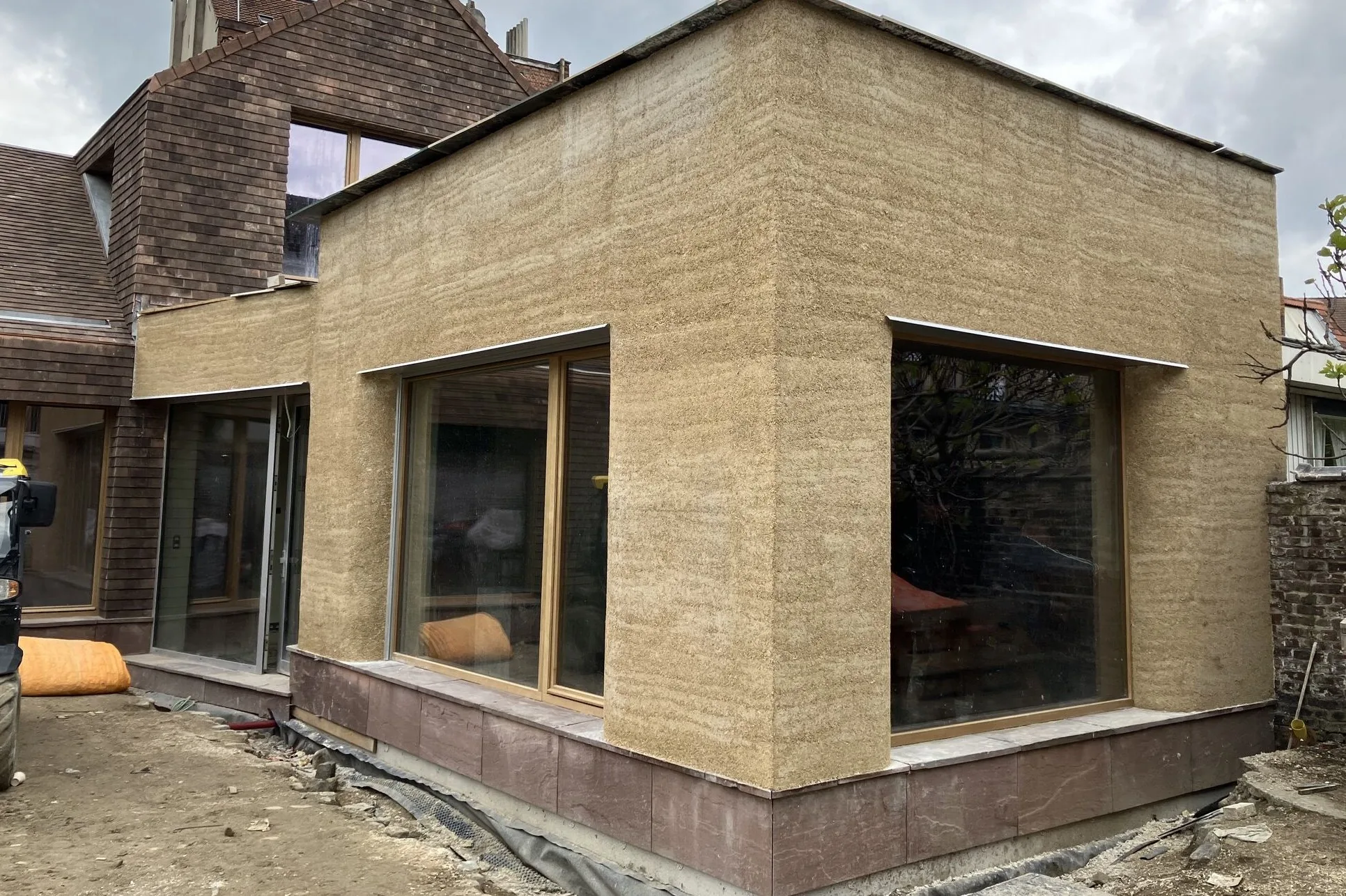
Wet hemp-lime
mix CaNaCrete
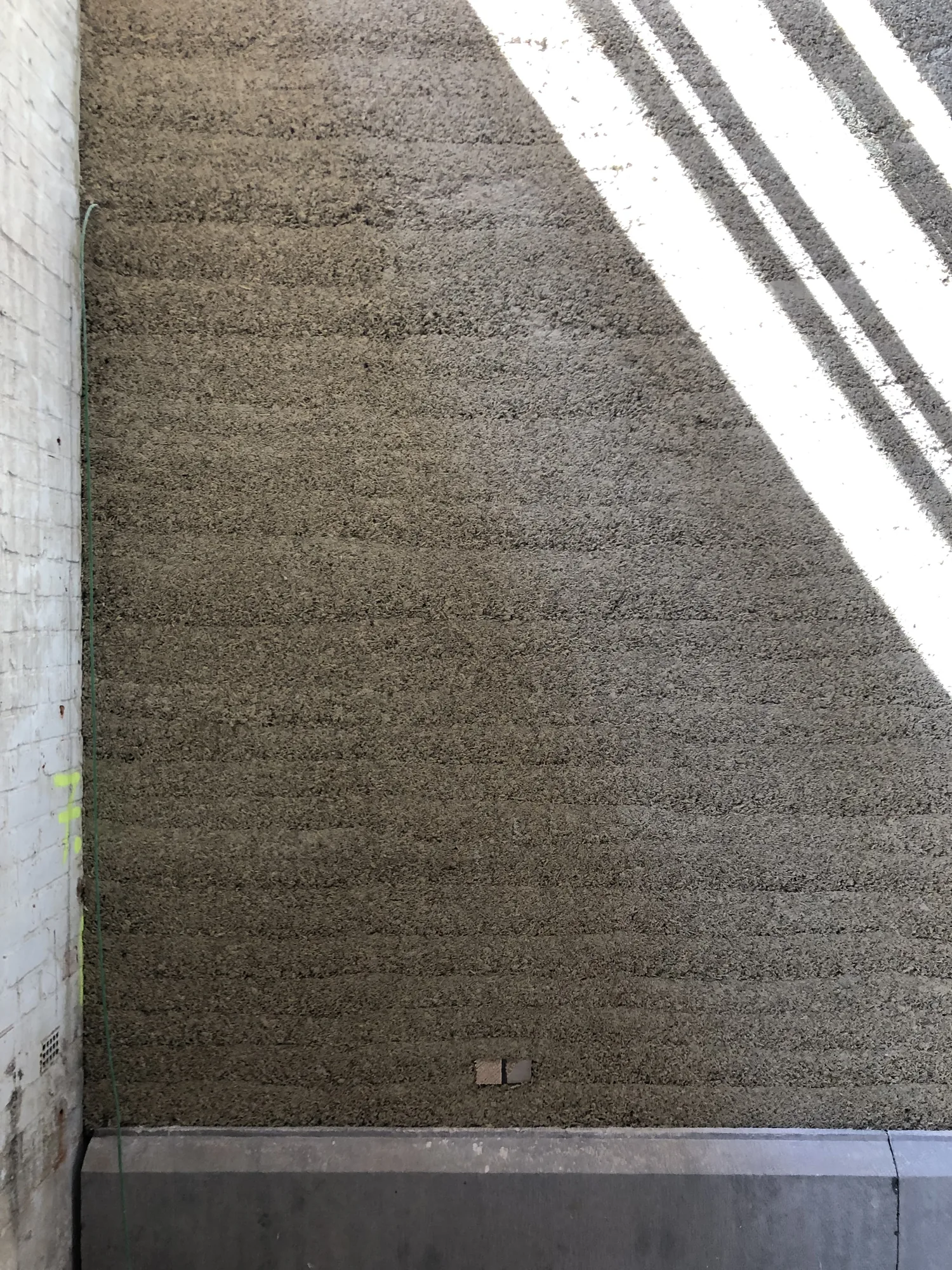
CaNaCrete is a wet hemp-lime mix delivered premixed to site. Poured into formwork around a loadbearing frame, it insulates interior and exterior walls and regulates humidity; indoors, it can be left exposed.
What is a wet hemp-lime mix?
CaNaCrete is a wet hemp-lime mix: traditional hempcrete, delivered already mixed. It combines hemp shiv, the woody core of the hemp stem, with hydrated lime, an Exie additive and water. Each particle of shiv is coated with lime: the shiv acts as a light, porous aggregate, while the lime binds the mix and hardens as it carbonates on contact with air.
Most of its qualities come from this porosity. It slows the passage of heat, with a thermal conductivity λd of 0.078 W/(m·K) at 275 kg/m³, and it absorbs sound. Combined with the mass of the wall, it also delays the thermal wave: the thermal phase shift reaches 16 hours for 24 cm.
Lime and hemp absorb and release water vapour. The wall stays open to vapour diffusion, with a μ of between 1 and 3, and buffers indoor humidity, provided the finishes are vapour-permeable too.
The material is non-loadbearing: it encases or lines a frame, most often timber, which takes the loads. Its reaction to fire is classed B-s1 d0.
Premixing sets it apart from hemp-lime mixed on site: it removes the need to mix on site and the time that takes. CaNaCrete is produced by Exie at Herzele, in East Flanders, from locally grown hemp decorticated by Exie.
Installation & uses
CaNaCrete insulates walls, inside and out, in new build, renovation and restoration. Being non-loadbearing, it is combined with a separate frame, most often use class 3 timber, which carries the floors, the roof and heavy loads. It is delivered wet in 1.2 m³ bulk bags and must be placed within 10 days of delivery.
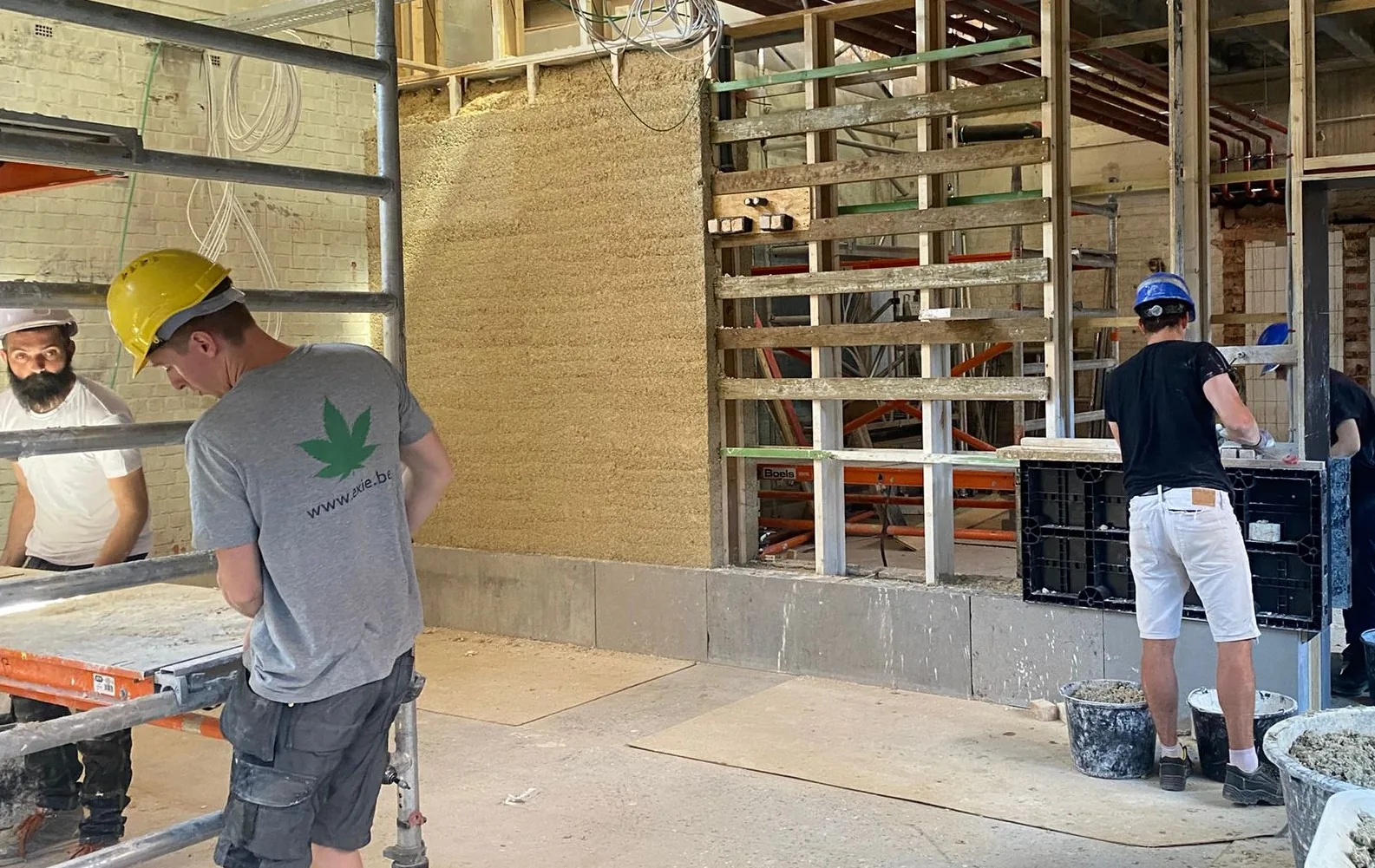
The mix is poured into temporary formwork of wood-based panels, removed as soon as the wall is filled, or into permanent formwork of reed or bamboo mats. It is placed in layers of 15 to 20 cm, lightly tamped: more firmly at the edges and more loosely in the middle, to retain the porosity. An encased frame needs at least 7 cm of cover, and the manufacturer advises filling a wall within a single day.
The base of the wall must stay dry, by means of a membrane, drainage or a clearance of at least 30 cm above ground level. Anchors are galvanised steel, and junctions with windows and doors are made airtight.
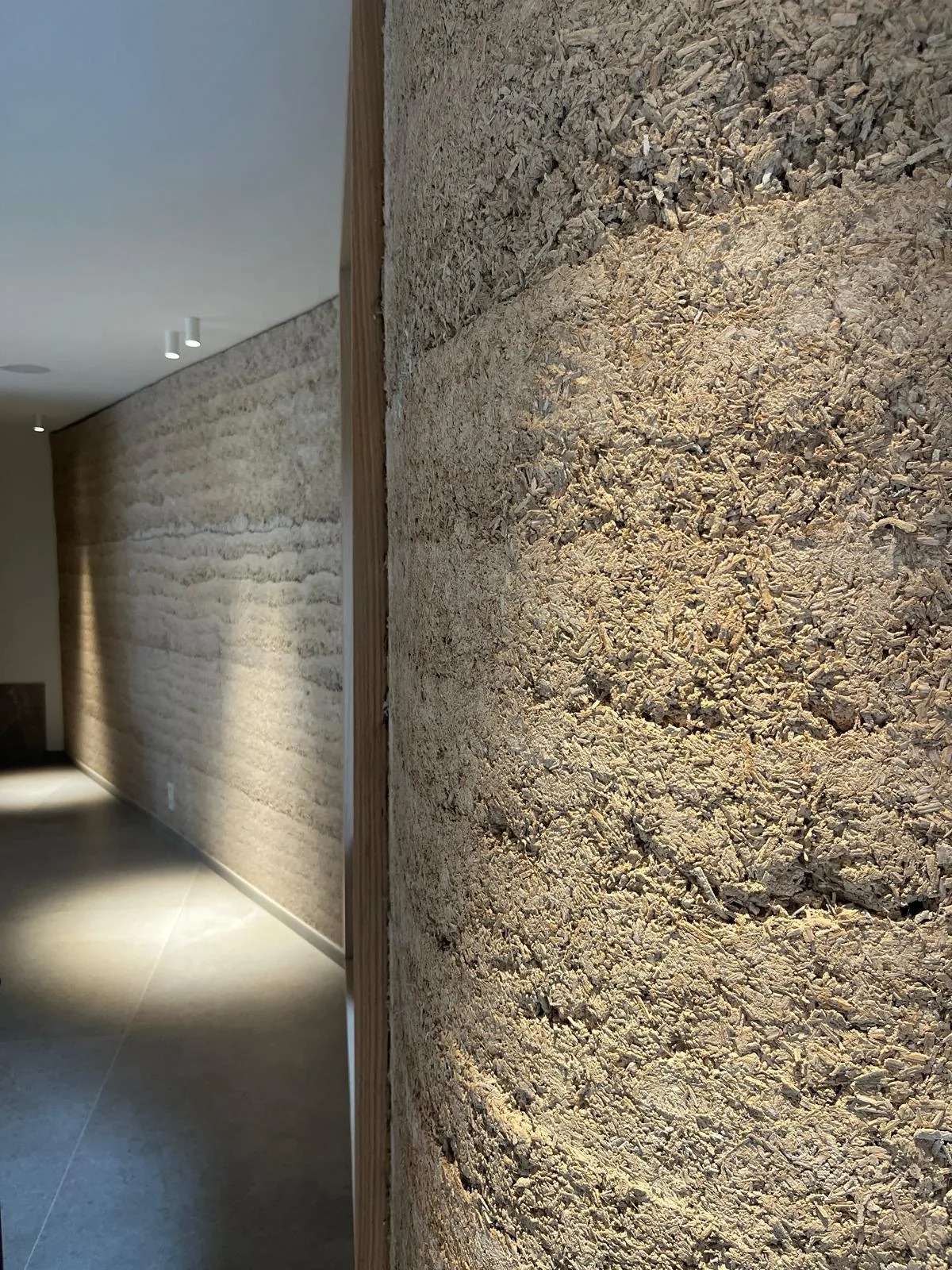
Drying takes about two weeks per centimetre of thickness, with good ventilation. Indoors, the wall can be left exposed or take a vapour-open lime or clay plaster, with no vapour control layer; clay plaster is applied to a fully dry wall. Outdoors, a suitable lime render, cladding or a ventilated facade protects it from driving rain.
About the producer
Exie is a Belgian producer of hemp-lime insulation, based in Herzele, in East Flanders. The company processes locally grown hemp into two mixes: CaNaDry®, a dry hemp-lime installed as loose-fill in floors, walls and roofs, and CaNaCrete, a pre-mixed wet hemp-lime for wall insulation.
Exie supports installation with guides specific to each application and with technical advice before work starts on site. CaNaDry® has a B-EPD environmental product declaration.
Technical performance
Life cycle
Hemp shiv, the woody core of the hemp stem, comes from a network of local farmers; Exie separates it from the fibres on its own decortication line. Each particle is coated with hydrated lime and an Exie additive.
Exie adds the lime, additive and water at Herzele, in East Flanders, about 50 km from Brussels, and feeds its production waste back into the process. The wet mix is delivered in 1.2 m³ bulk bags and is placed within 10 days.
Exie says it takes back its materials when a building is demolished, to feed them back into its production.
FAQ
How long should a CaNaCrete wall be left to dry?
About two weeks per centimetre of thickness, more or less depending on the climate and on the ventilation of the rooms, which must be kept well aired during this phase. Clay plaster is applied only to a fully dry wall.
Can CaNaCrete be left exposed?
Yes, indoors: the texture of the layers stays visible and the porous surface contributes to sound absorption. Outdoors, it must be protected from driving rain by a suitable lime render, cladding or a ventilated facade.
What formwork should be used?
Temporary formwork of wood-based panels (OSB, plywood), removed as soon as the wall is filled, or permanent formwork of reed or bamboo mats, which stays in the wall. In both cases it is fixed to a separate loadbearing frame.
How long does the delivered mix keep?
CaNaCrete is delivered wet and premixed, in 1.2 m³ bulk bags. It must be placed within 10 days of delivery, before it starts to harden and dry.
How does it differ from CaNaDry®?
CaNaCrete contains water: it is poured into formwork around a frame, insulates walls and needs drying time. CaNaDry®, Exie's dry hemp-lime, is installed without water or drying and is also used in floors, under screed, and in roofs.
Alongside
Same layer, same use · materials to compare.
Float glass with a high recycled glass content. AGC · Louvain-la-Neuve.
Softwood fibre, boards and blown-in loose fill. Best Wood SCHNEIDER · Eberhardzell.
100% recycled PVC, extruded profiles. Deceuninck · Hooglede-Gits.