
On October 6th, the Belgian Tool to improve the environmental impact of buildings (TOTEM) launched one of its biggest updates since its original launch. Sprint 12, as it is called, had been announced repeatedly in the months leading up to the update, and introduces some significant changes aimed at making the LCA-tool compatible with EPBD and BREEAM frameworks as well as expanding the component library with new elements and updating the generic component library to ecoinvent version 3.12.
Which raises the question: how do sustainable construction materials perform in the newest update? Have their scores been significantly changed? As we will see, some materials, like CLT, have seen their score significantly improved, while others, like flexible wood fibre insulation, are surprisingly penalised.
In the article below, we explore the key changes our experts have observed in TOTEM's latest update and what this means for your building calculations.
As stated in our previous article, the main goal of TOTEM's Sprint 12 update is to finally be EPBD-ready by aligning the tool's building life span to the new European standard. A building in TOTEM is thus assumed to last for 50 years, and not 60 as was previously the case.
Thanks to this change, comparing building-level results to international benchmarks becomes easier. While LCA methodologies vary slightly between EU member states and thus benchmarks are not fully comparable, using building impact figures from the French RE2020, Danish BR18, RIBA's Carbon Targets, One Click LCA Carbon Heroes and other sources can offer interesting insight for professionals trying to build a robust picture of where impacts come from and how they can be reduced in the future.
Most importantly however, TOTEM results are now aligned with international frameworks like BREEAM and EU Taxonomy, and make the tool ready for the new EPBD regulation which will see embodied impacts integrated into the energy performance assessments of buildings from 2028.
The switch to 50 years does mean that building level calculation results from before the update are not comparable anymore to those obtained today, since the building lifespan also has an impact on component use cycles: if before a layer of paint with 10-year life cycle had to be substituted 5 times during the building lifetime, now it only requires four replacements, which translates to an impact reduction of 17%. TOTEM has therefore also recalculated its benchmark values.
We have observed reductions in environmental score for several structural timber elements. A 10 cm CLT panel, for example, has dropped from 3.96 mPt/m² to 3.33 mPt/m², a 16% reduction over the whole life cycle. Glulam beams have even dropped by 30% on the total life cycle impact (from 56 mPt/m³ to 39 mPt/m³). Lastly, TJI joists seem to have improved by 17%, LVL beams by 10% and also mass timber has seen an improvement of around 7% over the whole life cycle.
As a result, wood-based structures will see their scores improve between 10 and 30%. The improvement will be welcomed by many in the sector, since the impact of structural timber in TOTEM has long been a controversial topic. A 2021 review by Arup already showed that EPDs from Glulam and CLT manufacturers (weighted by market share) scored about 45% better than the generic values in national databases. Thanks to the new values in TOTEM the gap has been somewhat reduced.
However, as with all generic datasets, the gap with specific components is still large. For example, the CLT products by Stabilame, for which specific data is available in TOTEM, score a lot better with only half the impact of the generic CLT (1.62 mPt/m² for 10 cm). For mass timber, generic joists score 40% higher than the dataset provided by the national technical wood construction centre Houtinfobois.

One of the most striking changes in the updated component library are flexible wood fibre insulation boards. While before the Sprint 12 update flexible wood fibre insulation was among the bio-based components with a good score and close to market EPDs, now the material's impact has more than doubled in total environmental impact, going from 4.1 mPt/m³ to 8.6 mPt/m³ (A1-C4). That is an increase of 110 percent! For reference, rock wool insulation as of today has a score of only 3.95 mPt/m³. What happened there?
It is difficult to say why the component scores as it does, since TOTEM is not transparent about assumptions, allocation and background datasets it employs for generic calculations.
However, what we can do is to look at the indicators that drive the change, and compare the new flexible wood fibre component to products that are actually on the market, as fortunately, most producers have EPDs available. So, what do we see?
Well, when looking at the impact profile in TOTEM, one quickly notices that the production impact is mainly driven by 5 indicators: GWP-fossil, Acidification, ADP-mineral, Particulate Matter emissions and Land Use. Together these represent 90% of the impact profile. Interestingly, all of these indicators have sharply risen since the latest update. While GWP-fossil doubled, AP and ADP even quadrupled.
When comparing TOTEM's flexible wood fibre data with the median value of available market EPDs (from Soprema, Isonat, Gutex, Semin and Thünen's generic dataset), we see that in terms of Global Warming Potential (kg CO2 eq), TOTEM is actually not that far off the market average, with a GWP-fossil score around 47 kg CO2 eq/m³. An overshoot of 20% is reasonable for generic components.
Rather, the impact is strongly driven by the other non-CO2 indicators. TOTEM's results for these indicators are an order of magnitude higher than those reported in market EPDs, overshooting these values by a factor of 3 for Particulate Matter emissions and factor 13 for the other indicators. This of course is a questionable observation. If the non-CO2 indicators were closer to the market EPDs, the mPt results for flexible wood fibre could be reduced up to 73%.
Lastly, the increase for flexible wood fibre is also surprising because rigid wood fibre panels, which have a very similar production process, have themselves dropped about 20% in life-cycle impact (30% for A1-A5).
Since flexible wood fibre is one of the most widely used and technically mature bio-based insulation materials, and a strong competitor to mineral wools and petrochemical solutions, this unusual increase deserves to be looked at more closely to ensure fair comparisons between materials.
Table: analysing key drivers of flexible wood fibre's impact in TOTEM and comparing with market EPDs for A1-A3 impacts.
| Indicator | Unit | Value/FU A1-A3 | mPt/FU A1-A3 | %mPt A1-A3 | Difference after Sprint 12 | Share of the Sprint 12 score increase | Distance TOTEM to market median | TOTEM overshoot of market median |
|---|---|---|---|---|---|---|---|---|
| GWP-fossil | kg CO2 eq / m³ | 47 | 1.3 | 23% | 102% | 17% | -16% | 19% |
| AP | mol H+ eq / m³ | 1.2 | 1.4 | 24% | 409% | 25% | -93% | 1346% |
| ADP-minerals&metals | kg Sb eq / m³ | 0.0009 | 1.1 | 19% | 438% | 20% | -93% | 1386% |
| PM | disease incidence / m³ | 0.0000052 | 0.78 | 14% | 124% | 10% | -73% | 268% |
| SQP (land use) | dimensionless (pt) / m³ | 5580 | 0.54 | 9% | 232% | 9% | -92% | 1232% |
| 90% cumulated | 81% cumulated |
In the domain of rigid insulation panels, the evolutions are less spectacular. The most visible changes in component impact can be noticed for wood fibre insulation panels and polyurethane products.
Contrary to flexible mats, rigid wood fibre boards have received a moderate improvement of 22% since October. Their impact now floats around 8.81 mPt/m³, down from 11.4 mPt/m³. This decrease is mostly driven by a reduced ecotoxicity score.
Moving on, the petrochemical sector will be happy to see that both PUR insulation panels and PUR foam have seen one of the biggest score improvements of the Sprint 12 update.
PUR panels have decreased by about 38% over the life cycle, while PUR foam has decreased by an impressive 52%, now scoring 21 and 15 mPt/m³ respectively. In both cases the decrease is driven by drastically lower Ecotoxicity and Human toxicity scores.
Despite this change however, PUR panels still clearly perform worse than their bio-based alternatives. A 120 mm polyurethane panel scores almost 40% higher than an equivalent wood fibre panel with 200 mm thickness over the whole life cycle. And as always, comparing the upfront carbon at construction (A1-A5) shows the other great advantage of bio-based insulation, its GWP score being only one fourth of polyurethane.
As has been indicated for a while now, generic hemp-lime components can hardly be considered representative of the hemp-lime products that are used on the Belgian market today, and tend to misrepresent hemp-lime as a high-impact material while in most cases it does outperform conventional materials.
As of the Sprint 12 update, this situation has not been changed. Both loose-fill hemp-lime and hemp-lime blocks actually increased by about 10% in environmental score.
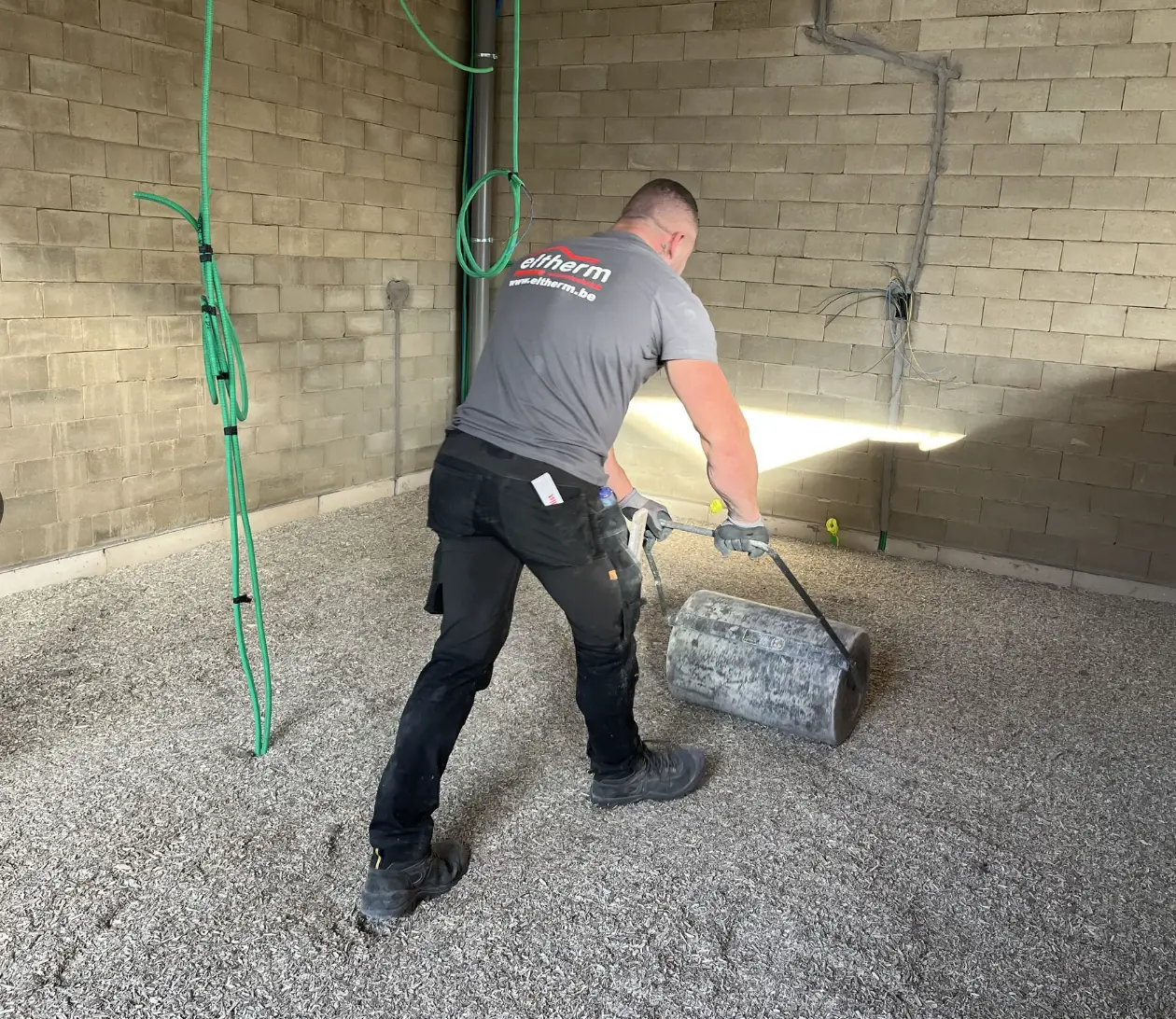
The fact is that today, the use of hemp-lime in Belgium is dominated by two manufacturers, Isohemp for hemp-lime blocks and Exie for loose-fill in walls and floors, and luckily both of them have published B-EPDs so they are visible in TOTEM.
Comparing these products to their generic counterparts gives an idea of the gap. For a loose mix, TOTEM declares an impact of 27 mPt/m³ while the impact of Exie CaNaDry is actually 5.2 mPt/m³. That is 80% less impact.
Looking at hemp blocks, the difference is less pronounced: 17.3 (generic) versus 13.7 (Isohemp blocks) mPt/m³. However, the generic component still counts double the amount of carbon emissions (kg CO2 eq) compared to the specific hemp blocks. (The gap becomes a lot greater when the blocks are combined with a generic loose-fill layer between block and wall.)
Thus, if you think about using hemp-lime in a project and evaluate the benefits with generic components in TOTEM, you will overestimate the impact of the products that you will most probably work with in reality. Admittedly, not everyone works with Exie or Isohemp and it is true that a different hempcrete mix with higher lime contents would probably have higher impacts.
This, however, is not a representative case for most construction projects. Despite this fact, multiple institutions have used TOTEM's generic values to question the environmental benefit of hemp-lime products. Such was the case for Buildwise's latest technical report or websites like milieubewustisoleren. Thanks to the efforts of producers to publish EPDs the picture has become much more nuanced.
One final point: we are still waiting for TOTEM to add a generic dry-mix hemp-lime component. For the time being, we would advise everyone to work with Exie's CaNaDry component and not with the generic hempcrete one.
From a sustainability standpoint, façade renders are interestingly challenging to characterise: while they are extremely efficient in terms of material use and offer low upfront impacts, they also have clear downsides related to their shorter lifespan, their higher technical risks and a negative performance across the board on circularity.
As a result of Sprint 12, the impact of façade renders has generally decreased. The standard synthetic render has dropped by 15% over its life cycle, while trass-lime renders dropped by a remarkable 55%. A lime-based render now scores 25% better than a silicone-based one. (Note: in these figures, only phases A1-A5 and C1-C4 are taken into account, due to different lifespan assumptions by TOTEM, see below.)
However, TOTEM's default components compare these materials on an incorrect basis: the only available lime render for façades and ETICS systems has a default thickness of 30 mm, which for these applications is strongly overestimated.
Normal lime-based coatings on insulation boards have a total thickness from 10 to 15 mm. If you use the default element your coating is overestimated 2 to 3 times. At the same time, ETICS systems typically require a mesh between layers, which TOTEM also doesn't take into account.
Secondly, silicone-based coatings for ETICS are modelled by TOTEM as a single 2 mm layer of resin, but of course these coatings also require a base coat and mesh layer. Therefore, their impact is underestimated. (Component WS1866 does offer a more realistic composition with base coat and mesh, but lacks an adequate end-of-life scenario due to the different substrate.)
In conclusion, when comparing a lime-based coating with a more realistic 12 mm thickness to the 2 mm layer of synthetic resin, the difference is 72% in favour of lime. Similarly, compared to WS1866, the lime-based coating (without mesh) has 62% less impact.
In the coming updates, we hope TOTEM revisits the modelling of these components to ensure a correct calculation.
One thing to watch out for is that among the many options there are to model an insulation layer for ETICS systems there is quite a bit of variation between the assumptions that underpin the modelling.
Depending on whether you pick a generic insulation panel or one specifically denoted as “To be plastered”, the assumed lifespan can vary from 40 to 50 years. This small difference has quite a bit of influence: a panel with a 40 year lifespan will be replaced once during the building life cycle, doubling its impact compared to a “normal” panel. This might be unintuitive, since the products themselves are exactly the same.
Nevertheless, choosing panels with different lifespans can greatly distort your conclusions, for example when making a comparison between EPS, XPS, wood fibre or expanded cork. Users should therefore pay extra attention to comparing products that have matching life spans.
However, this is not always enough: for example, an exterior lime-based render has exactly the same lifespan as a silicone-based one (40 years), and still the lime-based coating is counted double while the other is not. It seems TOTEM uses a shorter overlap time for the lime coating, but since the application is the same, the question of why remains.
Other aspects can also lead to confusion or faulty comparisons, for example when selecting products from specific producers directly from the library instead of replacing them inside a generic component. In the first case the auxiliary materials like adhesive mortar and plugs are not taken into account.
Lastly, specific components (like ISOMO EPS panels) have a lifespan of 50 years, which eliminates the replacement obligation after 40 years and thus gives them an unfair advantage compared to generic equivalents. If you want to compare an ISOMO panel to a generic wood fibre panel, you will therefore have to pay attention to choose a 50-year panel instead of the ETICS variant.
Feeling confused? We understand you!

In terms of façade cladding, most components show no important changes after the Sprint 12 update. Wood-based claddings of all types do show a decrease of 6%, following the same trend as structural wooden elements. Most of this gain is due to an improved production score.
Of course, wooden façade claddings already offered by far the best score of any façade component in TOTEM. For example, wood cladding's score is so low that it far outweighs the downside of a shorter lifespan: you could throw away and incinerate four entire wooden façades before achieving the same impact as one single brick façade.
Other façade cladding materials have remained within the same range as before with their production impacts.
One interesting exception is copper roof cladding, which has seen its impact literally explode, rising by about 725% (!) from its previous figure. Most of this change is due to an enormous increase in the mineral resource depletion potential (ADP-mineral), although other indicators have also strongly increased.
In fact, not only copper sheets but all components containing the scarce metal, like electrical cables and pipes, have seen strong increases. Electrical cables now score 5 times higher than before, while piping for water transport scores 1 to 6 times higher depending on the component. This will strongly influence the relative weight of technical installations in the total impact profile of buildings.
As users we cannot determine the exact reason for this enormous increase in copper's impact. However, the scale of the change suggests a shift in assumptions about the raw materials, where possibly higher amounts of primary copper are assumed, as well as higher grade material suited for building applications. Copper, of course, is not only a highly energy-intensive material but also increasingly rare, copper prices having tripled since 2005.
Nevertheless, it would be interesting to hear from TOTEM the exact causes for this increase and whether similar evolutions could be expected for other resources which are under increasing pressure in the coming years.
In terms of interior finishing materials, there are a few small changes to gypsum boards and floor screeds which might still impact whole building results.
Firstly, gypsum boards have seen their impact drop by about 12% over the life cycle. While the change is only moderate, its effect will still be noticed especially in buildings which integrate a lot of structural wood.
These buildings tend to integrate a lot of gypsum panels for acoustic and fire safety reasons, and we have observed that combined with their relatively short lifespan, the gypsum boards can negatively affect the total environmental score of a timber building. Thus, due to the many layers and life cycles of the boards, the 12% drop in gypsum impacts could actually multiply several times and thus prove to be a noticeable win for timber based buildings.
Contrary to gypsum, cement screeds have seen a slight increase of 7% on average. Again, while this will not noticeably affect the results for conventional buildings, it is still a relevant change for buildings with lightweight timber structures where mineral materials used in interiors take a larger share of the total impact. However, we do not expect the increase in cement screed impacts to outweigh the gains related to gypsum boards.
Some other noticeable changes for interior components include a remarkable rise in the impact of coconut fibre, which rose elevenfold due to an explosion of the Land Use indicator (a questionable evolution since most coconut fibres used in construction products are a biomass waste flow from plantations), and a 30% increase in the impact of linoleum flooring, which despite this still scores better than other flooring materials like PVC or tiling.
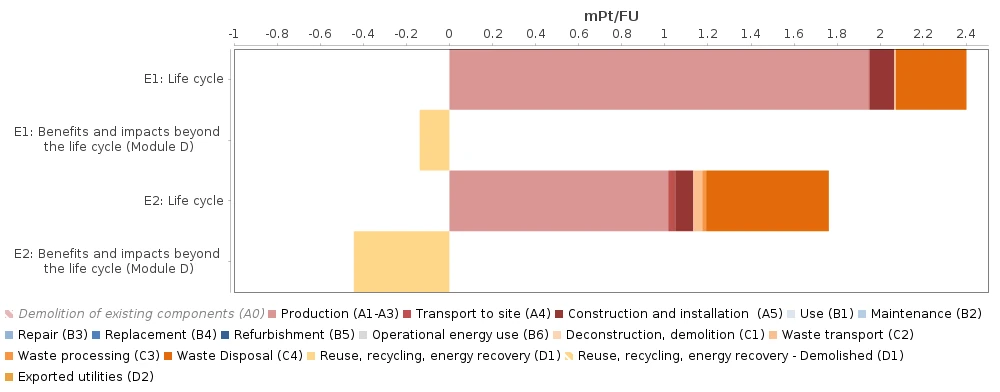
Change in the environmental score (mPt) of generic TOTEM components, before and after the update.
So, what do we as experts take away from this update?
First of all, Sprint 12 is a necessary step bringing TOTEM in line with Level(s), BREEAM and the coming EPBD requirements. The 50-year reference period and update to ecoinvent 3.12 ensure that TOTEM is ready for the coming evolutions in building LCA.
Due to the updated background database, many materials have seen their environmental score improve. This includes most wood-based products, including structural timber like CLT, Glulam and LVL, as well as mass timber, rigid wood fibre insulation and wood claddings, but also non-bio-based materials like polyurethane and gypsum.
In contrast, some materials have also seen their environmental score become worse, in some cases even spectacularly like flexible wood fibre insulation and copper-based products like roofing sheets, electrical components and heat pipes.
Most of the changes are not related to carbon (GWP), but to other lesser-known indicators like toxicity and resource depletion.
The latest update has also brought an important list of new additions to the component library including photovoltaic panels and other technical components.
The Sprint 12 update shows how much a single score can move for reasons that have little to do with the product itself: “silent” changes in background datasets, reference service life assumptions, differently weighted indicators etc. This again underlines the necessity of being able to dig into the mechanics and assumptions of TOTEM calculations in order to correctly interpret and assess their outcomes.
This is our call to designers and TOTEM users, but also to the developers of the tool itself. Having better access to the assumptions and datasets that lie beneath every generic component would improve the sector's ability to critically interpret and use the environmental scores that come out of it.
But until then, we are ready to support the building sector with its calculations in TOTEM.
Need an LCA study for your project? Read more here.
Photos: Best Wood Schneider · Exie · VestaEco. Chart: screenshot from TOTEM.
Two pieces from the Magazine on TOTEM and on the materials discussed here.
Announced on 6 October, the TOTEM update brings the study period down from 60 to 50 years.
Belgium is more than ready for the transition in construction, and it is not talked about enough.